The Product Of 7 And J Is 91
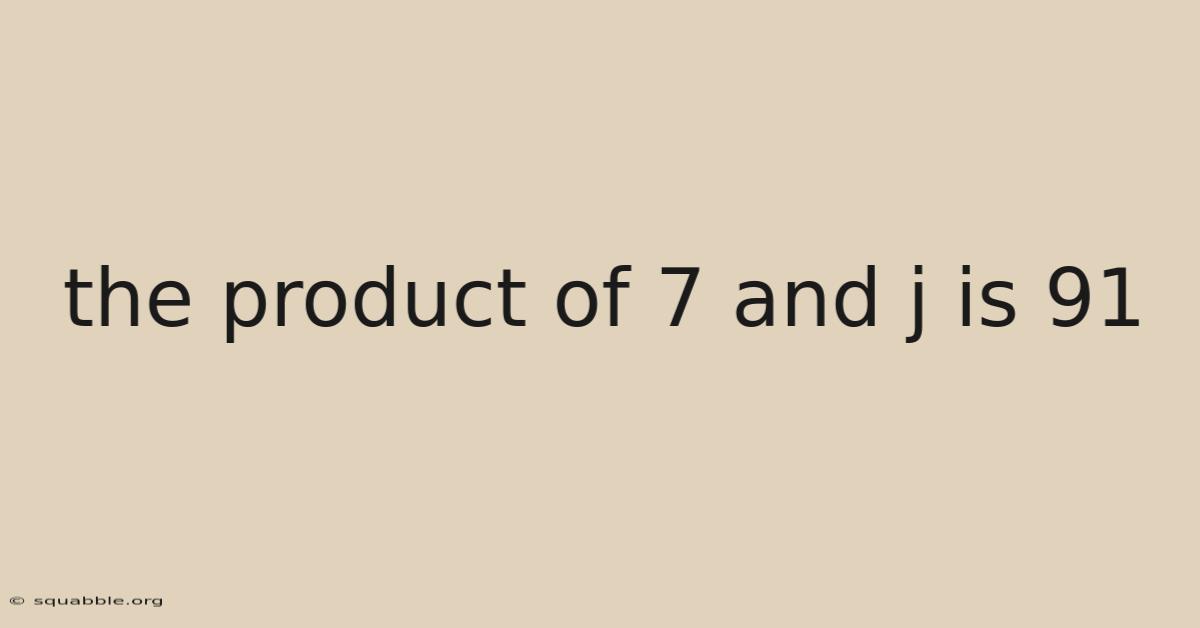
You're staring at a homework problem. The line reads: the product of 7 and j is 91*. Or maybe you're helping a kid with theirs. Find j.
Your brain does the thing brains do — it either clicks instantly or it freezes. If it clicked, you're already done. If it froze, you're not alone. This exact phrasing trips up more people than the math itself.
Let's talk about why.
What "Product" Actually Means Here
Product. It's one of those words that sounds formal but just means multiply*. In practice, that's it. No hidden trick. When a math problem says "the product of A and B," it's handing you a multiplication sign on a silver platter.
So the product of 7 and j is 91* translates cleanly to:
7 × j = 91
Or, since we usually write variables next to coefficients: 7j = 91
The letter j is just a placeholder. Even so, could be x, n, t, or a little box. Doesn't matter. It's the number we don't know yet.
Why the wording throws people
"Product" feels like vocabulary. But here's the thing — you already know this word. Plus, memorization feels like pressure. Vocabulary feels like memorization. You use the concept every time you calculate a total price for multiple items, or figure out how many slices in 7 pizzas if each has 8.
The math isn't new. The label is.
Why This Kind of Problem Shows Up Everywhere
You'll see this exact structure — coefficient × variable = constant* — in places that don't look like math class.
- Unit pricing: 7 apples cost $91. How much per apple?
- Rate problems: A car travels 7 hours and covers 91 miles. What's the speed?
- Scaling recipes: The original batch uses 7 eggs and makes 91 cookies. How many cookies per egg? (Weird recipe, but roll with it.)
- Finance: 7 equal payments total $91. What's each payment?
Same skeleton. Here's the thing — different skin. Recognizing the pattern means you stop solving each one from scratch and start seeing the template.
How to Solve It (Without Guessing)
Step 1: Write it down properly
Don't do it in your head. Not yet. Write:
7j = 91
Writing it externalizes the working memory load. You free up brain space for the actual logic.
Step 2: Isolate the variable
j is multiplied by 7. To get j alone, you do the opposite — divide both sides by 7.
7j ÷ 7 = 91 ÷ 7
The 7s on the left cancel. You're left with:
j = 91 ÷ 7
Step 3: Do the division
Now it's just arithmetic. 91 divided by 7.
If you know your multiplication tables backward, you already see 13. If not, here's a quick mental path:
- 7 × 10 = 70
- 91 − 70 = 21
- 7 × 3 = 21
- 10 + 3 = 13
So j = 13.
Step 4: Check it (the step everyone skips)
Plug 13 back into the original statement. The product of 7 and 13 is 91.*
7 × 13 = 91. ✓
Takes three seconds. Catches sign errors, division slips, misread coefficients. Do it every time.
Common Mistakes (And Why They Happen)
Mistake 1: Adding instead of dividing
Some brains see "7 and j" and think sum. They write 7 + j = 91. Then j = 84.
Why it happens: "And" usually signals addition in word problems. "Product" is the override keyword. Train yourself to pause at product*, quotient*, difference* — they're operation signals, not conjunctions.
Mistake 2: Dividing the wrong number
91 ÷ 7 = 13. But a rushed student might do 7 ÷ 91 and get a decimal, or 91 ÷ 13 and get 7 (which is true but answers the wrong question).
Want to learn more? We recommend do pimple patches get rid of pimples and can you put bleach in dishwasher for further reading.
Why it happens: The numbers are sitting right there. The brain grabs the easiest division. Slow down. Ask: What am I solving for?* You want j, so j must end up alone on one side.
Mistake 3: Forgetting the variable
Writing "91 ÷ 7 = 13" and stopping. No j =. The answer isn't a number — it's j = 13*.
Why it happens: The arithmetic feels like the finish line. It's not. The variable statement is the finish line.
Mistake 4: Sign errors with negatives
If the problem were the product of -7 and j is 91*, the answer is j = -13. If it were the product of 7 and j is -91*, answer is j = -13. If both negative, j = 13.
Why it happens: Negative rules are a separate cognitive load. Practice them in isolation until they're automatic, then combine.
Practical Tips That Actually Work
Say it out loud
"The product of 7 and j is 91." Read it. Practically speaking, hear the word product*. Let it trigger multiply*. Auditory processing catches what visual scanning misses.
Use a placeholder box first
☐ × 7 = 91
Solve for the box. Then replace the box with j. Strips away the "scary variable" anxiety.
Build a mental library of common products
7 × 13 = 91 isn't a standard times-table fact (tables usually stop at 12). But 7 × 10 = 70 and 7 × 3 = 21 are. But decompose unfamiliar products into known chunks. This scales to algebra later: 7(x + 3) = 7x + 21.
Write the inverse operation explicitly
Don't just think "divide by 7." Write:
**
Write the inverse operation explicitly
Don’t just think “divide by 7.” Write it out:
[ 7 \times j = 91 \quad\Longrightarrow\quad j = \frac{91}{7} ]
Seeing the fraction bar forces you to treat the division as the inverse of multiplication. It also makes the algebraic manipulation explicit, which helps when the equations get more complicated (e.g., (3x - 5 = 22) becomes (3x = 27) → (x = 9)).
A quick “sanity‑check” routine
- Re‑read the original wording. Does the answer make sense in context?
- Plug the value back in. Verify the product (or sum, difference, etc.) matches the given number.
- Check the sign and magnitude. If you expected a positive answer but got a negative, revisit the steps that introduced the sign.
Doing these three checks takes less than ten seconds but eliminates the majority of careless errors.
Mini‑drills you can do in a coffee break
- Flip‑the‑sign practice: Write a dozen equations of the form “(a \times x = b)” with random (a) and (b) (including negatives). Solve each, then verify by multiplication.
- Box‑to‑variable transition: Solve ( \square \times 5 = 85) and then replace the box with a variable (x).
- Word‑to‑symbol translation sprint: Read a sentence like “The quotient of (y) and 4 is 12” and write the equation (y \div 4 = 12) within five seconds.
Repeating these micro‑exercises builds automaticity, so the steps become second nature.
When the problem gets a little messier
Suppose you encounter: “The product of (2) and the difference of (j) and (5) is (28).Practically speaking, ”
- In practice, translate: (2 \times (j - 5) = 28). 2. Now, divide both sides by 2: (j - 5 = 14). Practically speaking, 3. Add 5: (j = 19).
Notice how the same “inverse operation” mindset carries over, only now you’re juggling parentheses and multiple steps. The key is to isolate the variable one operation at a time, always asking, “What undoes this?”
Conclusion
Algebraic statements may look intimidating at first, but they are just concise sentences that encode a clear arithmetic relationship. So by systematically identifying the keyword that signals the operation, translating the sentence into an equation, isolating the unknown through inverse operations, and then double‑checking the result, you can turn any such statement into a reliable answer. Practice the translation steps in bite‑size drills, keep a mental library of common products and quotients, and always write the inverse operation explicitly. With these habits in place, solving for a variable becomes a predictable, almost mechanical process — one that you can trust, every time.
Latest Posts
Hot Topics
-
What Are The Three Basic Components Of An Atom
Aug 02, 2026
-
Does Gas Have A Definite Shape
Aug 02, 2026
-
Vertical Columns On The Periodic Table Are Called
Aug 02, 2026
-
Does Uracil Have A Methyl Group
Aug 02, 2026
-
Which Solutions Showed The Greatest Change In Ph Why
Aug 02, 2026
Related Posts
Follow the Thread
-
The Process By Which A Gas Changes Into A Liquid
Aug 01, 2026
-
American Chemical Society General Chemistry 2 Exam
Aug 01, 2026
-
Where Can I Get Salicylic Acid
Aug 01, 2026
-
Only Letter Not On The Periodic Table
Aug 01, 2026
-
What Are The Three Basic Parts Of An Atom
Aug 01, 2026
